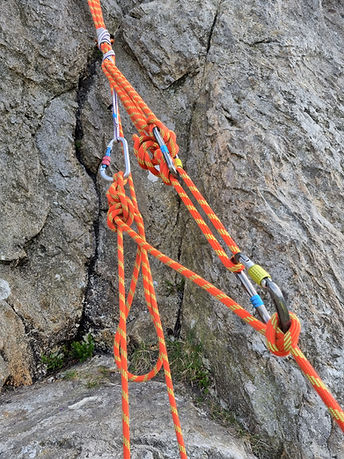
Learn practical ropework and problem-solving skills to help you manage common climbing incidents and unexpected situations with greater confidence.
Our Climber's Self Rescue courses are designed for experienced outdoor climbers who want to become more self-sufficient on single-pitch and multipitch routes, particularly when progressing onto mountain crags, sea cliffs and more committing climbs.
You'll learn how to avoid problems where possible and develop a toolkit of practical techniques for situations such as assisting a struggling climber, ascending a rope, dealing with stuck or damaged ropes, lowering, hoisting and retreating from a route.
Choose between our Self Rescue Basics course, which develops the fundamental techniques every independent climber should understand, and our Advanced Self Rescue course for climbers wanting to tackle more complex multipitch and casualty-management scenarios.
Courses are available at selected climbing locations across the UK, including Dartmoor, the Wye Valley, Eryri / North Wales and South Wales, with private courses tailored around your experience and objectives.
Instructor Tip:
" When ascending a rope, ALWAYS back the rope up below you. Clove hitch it to your belay loop and adjust it every few metres (removing the slack), or tie a knot. If your prusik slips, you won't slide down the full length of the rope! "
£150 - £260pp*
1-2 Days
1:4
* Price indicated is for public course dates. For private/bespoke/1:1 bookings, prices start FROM £250 per day, +£30 per person extra per day.
Get in touch to enquire or click the BESPOKE BOOKING button above.

1-2 Days Self Rescue Course:
The Basics
COURSE OVERVIEW:
Think of climbing self-rescue as a little like first aid: the first priority is avoiding problems in the first place, but when something unexpected happens, having a practical set of techniques can make a huge difference.
This 1 or 2-day course introduces the core ropework and problem-solving skills that independent climbers can use to manage common difficulties on single-pitch and multipitch routes.
You'll learn techniques such as tying off a belay device, ascending a rope, assisting or hoisting a climbing partner, controlled lowering, passing knots and managing abseil problems.
Just as importantly, we'll look at assessing the situation, choosing an appropriate solution, avoiding making things worse and recognising when the best option is to call for external assistance.
On the 1-day course, we'll concentrate on learning and practising the fundamental techniques in a controlled environment before applying selected skills on the crag.
On the 2-day course, we'll have more time to consolidate the techniques before introducing realistic climbing scenarios where you'll need to assess the problem and decide which skills to use.
Private courses can be adapted around your existing experience, the type of climbing you do and the situations you particularly want to prepare for.
The exact venue and scenarios will depend on your chosen location, experience, weather and conditions.
These skills will help you solve some of the less serious problems you may encounter, but they provide the foundation for more advanced, serious rescues.
The skills learnt on this course can help resolve the following example problems:
-
Assisting a climbing partner past the crux move if they can't do the moves
-
Lowering a climber safely and in control - they may have dropped some gear on a ledge or need lowering back to the belay ledge/ground
-
Dealing with a stuck rope whilst abseiling - are both ends in reach? Can you ascend the rope back to the anchor?
-
You've abseiled to the wrong ledge on a sea cliff and the climbing is too hard to climb back out
-
Abseiling and/or lowering on a damaged rope
Plus other problems that may occur. These are just a few examples.
1 Day course: We will start the day going through some of the basic techniques on the ground before rigging the crag and going through some of the techniques for real.
2 Day course: We will focus on learning the basic techniques on day 1 and take some of them to the crag by the end of the day. On day 2, we will focus a majority of the day on a multipitch climb and throw in real life problems to solve throughout the climb. Or continue to practice the skills from day 1.
On a bespoke course, I can tailor the day to suit you. Whether you have some knowledge of problem solving or are a complete beginner. I can work with you to develop your skills and adapt the day to your climbing goals.
This course is run on Dartmoor, in Snowdonia or in South Wales.
WHO'S IT FOR?
This course is ideal for climbers who:
-
already lead traditional routes and have some experience of multipitch climbing;
-
want to progress towards sea cliffs, mountain crags or more committing routes;
-
want greater confidence dealing with common ropework problems;
-
regularly climb with partners and want a broader problem-solving toolkit;
-
are planning longer or more remote climbing objectives;
-
have encountered a problem or near miss and want to improve their ability to respond.
-
You don't need previous self-rescue training, but you should already be comfortable with normal climbing equipment, belaying, knots and basic climbing systems.
DIFFICULTY:
(5/10) MODERATE
Low physical intensity but high technical focus, learning essential rope problem-solving skills in a controlled environment.
Similar difficulty to: Climbing Skills - Build Better Belays
Easier Than: Climbers Self Rescue - Advanced
Harder Than: Intro to Trad
Not sure what this means? See our Difficulty Guide → HERE
Compare other Rock Climbing Courses
COURSE CONTENT:
On this self rescue for climbers course, we will cover the following skills:
Problem Prevention & Assessment
-
Problem avoidance
-
Assessing risk
-
Communication
-
Calling for help
Core Ropework
-
Tying off a belay plate
-
Ascending/descending a rope
-
Assisted and unassisted hoists
-
Controlled lowering
-
Passing knots
Retreat & Abseiling
-
Multipitch abseils
-
Dealing with stuck ropes
-
Managing damaged ropes
-
Abseiling past a knot
WHAT TO EXPECT:
-
2 Full days of practicing rescue skills in realistic climbing scenarios
-
Progressive learning in basic rescue techniques
-
A focus on managing situations, developing your rescue skills and assessing risks
-
Safe, friendly atmosphere with others passionate about climbing
-
A focus on your safety
-
Opportunities to build confidence in basic self rescue skills under the watchful eye of an experienced Mountaineering Instructor
-
1:2 ratio to focus on your personalised instruction
WHERE CAN I TAKE A CLIMBER'S SELF RESCUE COURSE?
Self-rescue techniques are transferable between climbing areas, but training in a realistic outdoor environment gives you the opportunity to practise using them in situations that resemble the problems you may encounter for real.
Dartmoor, Devon
Dartmoor provides an excellent environment for learning and practising climbing self-rescue skills.
Its granite crags allow us to combine controlled ropework practice with realistic climbing scenarios, including ascending ropes, hoisting, lowering, escaping systems and solving problems on single-pitch and multipitch terrain.
Venues are chosen according to the course, group, weather and learning objectives.
Explore Rock Climbing Courses on Dartmoor →
Wye Valley & Wintour's Leap
The Wye Valley provides a range of environments for developing climbing problem-solving and self-rescue skills.
Courses can focus on the ropework and decision-making required for independent trad and multipitch climbing, with suitable venues selected according to your experience, objectives, conditions and current access.
The area is particularly convenient for climbers travelling from Bristol, Gloucestershire, North Somerset, South Wales and the surrounding region.
Explore Rock Climbing Courses in the Wye Valley & Wintour's Leap →
Eryri / Snowdonia
Eryri provides an excellent environment for climbers preparing for longer mountain routes and more committing multipitch climbing.
Self-rescue training here can be placed within the wider context of mountain cragging, including communication, route access, retreat, incident management and making decisions in more complex terrain.
Explore Rock Climbing Courses in Eryri / North Wales →
Bespoke Locations
Private Climber's Self Rescue courses can be arranged at other suitable UK climbing venues.
If you're preparing for a particular type of climbing — such as sea cliffs, remote mountain routes or an overseas trip — your course can be tailored around the skills and scenarios most relevant to your objectives.
No events at the moment
Climbers Self Rescue Course Dates


1-2 Day Self Rescue Course:
Advanced Techniques
£150 - £260pp*
1-2 Days
1:4
* Price indicated is for public course dates. For private/bespoke/1:1 bookings, prices start FROM £250 per day, +£30 per person extra per day.
Get in touch to enquire or click the BESPOKE BOOKING button above.
COURSE OVERVIEW:
Advanced Climber's Self Rescue builds on the fundamental techniques and applies them to more complex multipitch and casualty-management scenarios.
It is designed for experienced climbers operating on mountain crags, sea cliffs and longer or more committing routes where straightforward retreat may not always be possible.
We'll explore how to escape from the climbing system, reach and assist an injured partner, manage traverse incidents, lower past knots, carry out accompanied or counterbalanced abseils and begin organising a controlled evacuation from a multipitch route.
Rather than simply learning individual rope tricks, the emphasis is on problem solving: assessing what has happened, identifying the hazards, deciding what outcome you're trying to achieve and selecting an appropriate technique.
Scenarios may involve conscious or unconscious casualties, inaccessible partners and situations where your normal climbing system needs to be reconfigured.
This is technically demanding training and is best suited to climbers who already have a good understanding of multipitch systems and fundamental self-rescue techniques.
These skills will help you solve some of the more serious problems you may encounter.
The skills learnt on this course can help resolve the following example problems:
-
Your climbing partner, who is seconding on the third pitch, has been hit by a loose rock and is hanging on the rope unconscious
-
Your climbing partner has fallen off a traverse and can't get back on the route
-
Your climbing partner is too injured/tired to descend off the route by themselves
-
You realise part way down an abseil that your ropes don't reach the ground and you have already abseiled several metres past a good anchor
Plus other problems that may occur. These are just a few examples.
On a bespoke course, I can tailor the day to suit you. Whether you have some knowledge of problem solving or are a complete beginner. I can work with you to develop your skills and adapt the day to your climbing goals.
This course is run on Dartmoor, in Snowdonia or in South Wales.
WHO'S IT FOR?
The Advanced course is aimed at climbers who:
-
have solid single-pitch and multipitch climbing experience;
-
already understand basic self-rescue techniques;
-
regularly climb on mountain crags, sea cliffs or remote multipitch routes;
-
want to improve their ability to manage more complex incidents;
-
are preparing for ambitious or committing climbing objectives;
-
are developing their technical ropework knowledge for professional or personal progression.
-
Completing the Climber's Self Rescue Basics course first is strongly recommended unless you already have equivalent experience.
DIFFICULTY:
(8/10) HARD - EXTREME
Technically demanding scenarios requiring concentration and problem solving. Minimal physical difficulty but very high skill level.
Similar difficulty to: Learn to Lead Trad (5 days)
Easier Than:
Harder Than: Guided Multipitch Climbing
Not sure what this means? See our Difficulty Guide → HERE
Compare other Rock Climbing Courses
COURSE CONTENT:
On this self rescue for climbers course, we will cover the following skills:
Escaping & Reconfiguring Systems
-
Escaping the system
-
In-reach and out-of-reach anchors
-
Lowering past knots
Casualty Management
-
Reaching an injured climber
-
Conscious/unconscious casualty management
-
Accompanied/counterbalanced abseils
-
Traverse rescues
Evacuation & Decision Making
-
Multipitch evacuation
-
Risk assessment
-
Communication
-
Calling for external rescue
WHAT TO EXPECT:
-
2 Full days of practicing rescue skills in realistic climbing scenarios
-
Progressive learning in advanced rescue techniques
-
A focus on managing situations, developing your rescue skills and assessing risks
-
Safe, friendly atmosphere with others passionate about climbing
-
A focus on your safety
-
Opportunities to build confidence in basic self rescue skills under the watchful eye of an experienced Mountaineering Instructor
-
1:2 ratio to focus on your personalised instruction
WHERE CAN I TAKE A CLIMBER'S SELF RESCUE COURSE?
Self-rescue techniques are transferable between climbing areas, but training in a realistic outdoor environment gives you the opportunity to practise using them in situations that resemble the problems you may encounter for real.
Dartmoor, Devon
Dartmoor provides an excellent environment for learning and practising climbing self-rescue skills.
Its granite crags allow us to combine controlled ropework practice with realistic climbing scenarios, including ascending ropes, hoisting, lowering, escaping systems and solving problems on single-pitch and multipitch terrain.
Venues are chosen according to the course, group, weather and learning objectives.
Explore Rock Climbing Courses on Dartmoor →
Wye Valley & Wintour's Leap
The Wye Valley provides a range of environments for developing climbing problem-solving and self-rescue skills.
Courses can focus on the ropework and decision-making required for independent trad and multipitch climbing, with suitable venues selected according to your experience, objectives, conditions and current access.
The area is particularly convenient for climbers travelling from Bristol, Gloucestershire, North Somerset, South Wales and the surrounding region.
Explore Rock Climbing Courses in the Wye Valley & Wintour's Leap →
Eryri / Snowdonia
Eryri provides an excellent environment for climbers preparing for longer mountain routes and more committing multipitch climbing.
Self-rescue training here can be placed within the wider context of mountain cragging, including communication, route access, retreat, incident management and making decisions in more complex terrain.
Explore Rock Climbing Courses in Eryri / North Wales →
Bespoke Locations
Private Climber's Self Rescue courses can be arranged at other suitable UK climbing venues.
If you're preparing for a particular type of climbing — such as sea cliffs, remote mountain routes or an overseas trip — your course can be tailored around the skills and scenarios most relevant to your objectives.
No events at the moment
Climbers Self Rescue Course Dates

WHAT'S NEXT
PROGRESS:
Keep practising these techniques regularly so they're familiar before you need them. Bespoke technical skills days can also be used to revisit particular systems or build scenarios around the type of climbing you're planning.
Please refer to my FAQ page for more general information and visit my DOWNLOADS page for kit lists and booking forms.